
Could individual therapy fit the relationship stress you’re carrying?
Individual therapy can fit relationship stress when you want to understand your own reactions, needs, patterns, or past experiences as they affect your relationships. Therapy is a clinical form of support for emotional struggles, mental health challenges, psychological trauma, and relationship issues, and it may explore past experiences to understand patterns.
Relationship stress can show up as repeated conflict, difficulty communicating, anxiety around closeness, uncertainty about identity or intimacy, or the effects of racism, homophobia, or transphobia. Those concerns do not automatically tell you which kind of care to choose. They give you a starting point for describing what is happening and what you want to understand.
Individual therapy focuses on your experience. That can be useful when you want space to examine how you respond, what you need from relationships, and how earlier experiences may shape your present thinking. It also has limits when the main concern depends on the interaction between two partners. Before you choose, ask what you want to work on, what kind of relationship-focused experience the therapist has, and whether the setting feels affirming of your identity and context.
RelationshipHQ offers therapy for individuals, partners, and families, and our individual therapy addresses concerns including relationships, anxiety, intimacy, identity-related stress, and experiences involving racism, homophobia, or transphobia. Through our therapy, you can explore how past experiences influence present thinking, relationships, and overall well-being. If you are considering a relationship problems therapist in New York or asking about an online format, use the questions in this guide to describe the kind of support you want.
Start by naming what the relationship stress is bringing up for you
Relationship stress becomes easier to discuss when you name the concern beneath the immediate conflict. You might be dealing with anxiety, relationship issues, depression, or another personal challenge. RelationshipHQ’s individual therapy also addresses work stress, low self-esteem, family-of-origin issues, and stress related to race, gender, or LGBTQ+ identity.
Start with the part that feels clearest rather than trying to explain the whole history at once. For example, you might say, “I keep shutting down during conflict,” “I feel anxious when someone gets close,” or “I want to understand how my past affects the relationships I have now.” These statements describe a concern without diagnosing you or your relationship.
A short preparation note can help you organize your first conversation. Write down:
- The relationship situation that prompted you to look for support.
- The feelings, reactions, or choices you want to understand.
- The pattern you have noticed more than once.
- The change in understanding or communication you would like to work toward.
- Any identity, cultural, family, or relationship context that a therapist should respect.
Possible therapy goals can include improving communication, managing stress, or working through the effects of past trauma. You can bring more than one goal, and you can say when you are still figuring it out. The first useful step is describing what you want help exploring.
RelationshipHQ defines therapy as healing and offers it for individuals, partners, and families. Our individual therapy includes relationship concerns alongside anxiety, intimacy, identity-related stress, and experiences involving racism, homophobia, or transphobia. That range means you can describe the connection between relationship stress and the other concerns you are carrying instead of forcing them into separate stories.
Notice when support could help you examine a repeating pattern
Repeating relationship patterns can give you a practical reason to consider individual therapy. The pattern might involve conflict that ends the same way, difficulty saying what you need, managing another person’s feelings at the expense of your own, pulling away when you want connection, or carrying anxiety from one relationship into the next. You do not need to decide why the pattern exists before seeking support.
A therapist can help you examine the parts of the pattern that belong to your experience. Therapy may explore past experiences to understand patterns, and possible goals include improving communication, managing stress, or addressing the effects of past trauma. Those possibilities are starting points, not predictions about what will happen in your care.
Use these questions to decide whether support would be useful to explore:
- What tends to happen just before the pattern begins?
- What do you notice in your body, thoughts, or emotions during it?
- What do you do next, and what response do you hope for?
- Does the same concern appear across more than one relationship or setting?
- What would you like to understand, express, or choose differently?
The purpose of these questions is not to assign blame. They help you bring a specific concern into therapy, where you can look at your own experience with more detail. Relationship stress can involve another person, but individual therapy begins with what you notice, remember, feel, and want to examine.
RelationshipHQ’s therapy offering gives you room to explore how past experiences influence present thinking, relationships, and overall well-being. Our process begins by learning about you before you choose a care experience and give consent to get started. That sequence gives you a way to describe the repeating pattern before deciding what kind of therapy support you want.
What should an affirming therapist understand about your context?
An affirming therapist should understand that your relationship stress may be shaped by more than the interaction you are having with a partner. Cultural background, race or ethnicity, class, religion, and spiritual beliefs can influence mental health and well-being. Your gender, sexuality, family expectations, community, and experiences of racism or discrimination may also affect how you understand closeness, conflict, safety, and vulnerability.
For transgender and gender-nonconforming clients, affirming practice includes therapist awareness, knowledge, and skills related to their concerns, along with interventions intended to be effective and affirming. A therapist does not need to assume that every LGBTQ+ or BIPOC client has the same experience. You should be able to describe what matters to you without defending your identity or translating your life into language the therapist will accept.
Identity labels alone do not establish a good fit. A study of queer and/or trans Black, Indigenous, and other People of Color notes that some QTBIPOC clients view therapy as having the potential to cause further harm. That finding supports a direct fit question: ask how the therapist understands affirming care and how they respond when a client says an approach does not feel right.
You can assess context in concrete ways. Ask whether the therapist has experience with the identities, relationship structures, and cultural concerns you want included in the work. Ask how they make room for your names, pronouns, family structure, faith, race, class, or community without treating those details as side issues. Notice whether the response is specific, respectful, and open to your correction.
You are allowed to make cultural responsiveness part of your decision. You are also allowed to stop explaining if the conversation makes you feel dismissed or pressured.
Our work leaves room for your specific identity, culture, relationship structure, and lived experience. You can bring those factors into the first conversation rather than treating them as separate from relationship stress.
Check the therapist’s relationship-focused experience and approach
A therapist for relationship problems should be evaluated by more than a title or a convenient location. A New York-focused therapist-selection guide recommends considering licensure, relevant specialization, experience, therapeutic approach, and cultural responsiveness. For relationship concerns, the guide also recommends looking for a therapist who focuses on couples counseling or has training in partnership dynamics.
Use those criteria to build a short list of questions rather than trying to judge fit from a profile alone:
- Does the therapist have the license required for practice in New York?
- What relationship concerns or partnership dynamics does the therapist commonly work with?
- How does the therapist approach communication, conflict, intimacy, or recurring patterns?
- What experience does the therapist have with LGBTQ+ clients, BIPOC clients, nonmonogamy, or other contexts relevant to you?
- How does the therapist respond when your goals or identity do not fit a standard relationship script?
- What happens if individual therapy shows that the relationship concern involves both partners?
A method name may matter less than how the therapist explains the method and connects it to your goal. You can ask for plain language. You can also ask what participation looks like between sessions only if that question matters to you; do not assume that every therapist uses the same structure.
Relationship-focused experience does not mean the therapist will decide who is right in a conflict. Individual therapy gives you space to examine your side, your history, your choices, and your needs. The therapist’s role and approach should be clear enough for you to decide whether that focus matches what you want. After the conversation, compare the therapist’s answers with the concern you named. A useful answer should address the question you asked in plain language and leave room for your identity, relationship structure, and goals. You can note whether the therapist explained their relationship-focused experience, approach, cultural responsiveness, and boundaries around individual work. This does not prove that care will be a fit. It gives you specific information to weigh alongside the therapist’s license and experience. If an answer stays general, ask one follow-up question about the concern you want to bring. If the response does not address an important context, say what you need clarified before deciding whether to continue the conversation. That comparison turns broad ideas such as “affirming” or “relationship-focused” into questions you can actually ask.
RelationshipHQ’s individual therapist specializes in couples, LGBTQ+, nonmonogamy, relational dynamics, and Gottman Therapy. Those areas may be relevant if your relationship stress involves partnership dynamics, identity, or a relationship structure that you do not want treated as a problem by itself. Ask about the specific concern you want to bring and how the available approach would address it.
What questions can reveal whether the care feels affirming?
Questions about affirming care can reveal how a therapist thinks, not just which identities appear in a profile. Cultural responsiveness includes awareness, knowledge, and skills related to the concerns of different clients, and affirming practice includes using interventions intended to be effective and affirming for transgender and gender-nonconforming clients.
You can ask:
- How do you understand affirming therapy for LGBTQ+ and BIPOC clients?
- How do you include race, culture, class, religion, or spirituality when those factors affect relationship stress?
- How do you work with gender identity, pronouns, sexual orientation, or coming out when they matter to the concern?
- What experience do you have with nonmonogamy or relationships that do not follow a standard script?
- How would you respond if I said an interpretation or question did not fit my experience?
- How do you distinguish support for my relationship concerns from pressure to preserve or end a relationship?
- How would you handle a concern that later seemed to involve both partners?
The last question is especially useful because it asks about boundaries without requiring you to decide the entire path in advance. A clear answer can help you understand whether the therapist sees your identity and relationship context as part of the work rather than as obstacles to it.
You can also notice your own response during the conversation. Do you feel invited to explain? Can you ask for a different word or pace? Does the therapist answer directly? These observations are not a clinical test. They are practical information about whether you want to continue the conversation.
RelationshipHQ’s identity-affirming approach includes Black, Brown, Indigenous, Queer, and TGNC people, and our process begins by learning about you before you choose a care experience. You can use the questions above to explain what affirming support means in your life and to decide what you want clarified before giving consent to get started.
How is individual therapy different from coaching?
Individual therapy and coaching can both involve reflection and conversation, but they should not be treated as interchangeable names for the same care. The selected New Mexico guidance describes therapy as a clinical practice for emotional struggles, mental health challenges, psychological trauma, and relationship issues. Therapy may explore past experiences to understand patterns.
RelationshipHQ describes coaching differently: coaching helps individuals, partners, families, and organizations uncover their own voices, insights, and answers. That description gives you a practical way to frame your choice. If you want clinical support for relationship issues, anxiety, identity-related stress, trauma-related effects, or patterns connected to your past, ask about therapy. If your request is better expressed as wanting support to uncover your own voice, insights, or answers, ask whether coaching fits the concern you want to bring.
The distinction is about the kind of help you are seeking, not about judging one option. You can write down the sentence that feels most accurate:
- “I want to understand how my past experiences affect my relationships.”
- “I want support with anxiety, identity-related stress, or emotional patterns.”
- “I want help clarifying my own answers and next steps.”
The first two statements point toward a conversation about therapy. The third points toward a conversation about coaching. If your sentence includes both, say both. You can ask how RelationshipHQ would understand the request before choosing a care experience.
Keep this decision tied to the concern in front of you. This guide focuses on individual therapy for relationship stress, so coaching should not become a substitute for discussing clinical support when that is what you are seeking.
RelationshipHQ offers coaching for individuals, partners, families, and organizations to help uncover their own voices, insights, and answers. We also offer therapy for individuals, partners, and families and define therapy as healing. When you reach out, describe the relationship concern and the kind of support you are considering so the care experience can be discussed clearly.
When might individual therapy not show the whole relationship picture?
Individual therapy may not show the whole relationship picture when the central concern depends on the interaction between two partners. One literature review argues that, for a married client, individual therapy may be less effective and may carry more potential for harm than combined individual and couples therapy. The same review argues that working with only one partner can limit information about reciprocal interactions and may affect the spouse, marriage, and client.
That argument is a reason to discuss scope early, not a rule that individual therapy is wrong for every married client. The review addresses a specific comparison and makes an argument about possible limitations. It does not give you a personal decision about which format to choose.
Ask yourself what the work needs to examine:
- If you want to understand your own history, reactions, identity, or choices, individual therapy may be the format you want to discuss.
- If the main concern is a repeated interaction that depends on both partners’ actions, ask how individual therapy would address that limit.
- If you want to begin with your own experiences and later involve your partner, ask whether a transition or separate form of care could be considered.
Some sources describe people beginning with individual therapy to process personal experiences and later moving to couples therapy. Others use both at the same time with different therapists. Those pathways show that the first format does not always determine the entire course, but they do not establish which path fits you.
Relationship concerns can involve your experience and a shared relationship system at the same time. State which part you want to examine first, then ask the therapist to explain what individual work can and cannot address. Scope can be clarified without deciding who is responsible for the problem. Describe the part you want individual therapy to examine, then ask what would remain outside that format. For example, if you want to understand your own reactions during conflict, say so; if you want to discuss a shared interaction, name that too. The point is to make the focus visible before you begin. You can also ask whether couples therapy or a combination of individual and couples therapy should be discussed, since some people start with individual therapy and later move to couples therapy, while others use both with different therapists. Those possibilities do not decide your care. They give you language for asking how the therapist understands the boundary between your individual experience and the relationship dynamic.
RelationshipHQ offers therapy for individuals, partners, and families, and we offer coaching for individuals, partners, families, and organizations. That range lets you ask a direct scope question about the concern you are bringing: whether you want individual therapy to explore your own experience, another format to address shared relationship dynamics, or a conversation about how those needs relate.
Use the first conversation to clarify the kind of care you want
The first conversation can help you turn a broad search into a clear care question. You do not need a polished explanation. Bring the concern, the pattern you have noticed, the context that matters, and the kind of support you are considering.
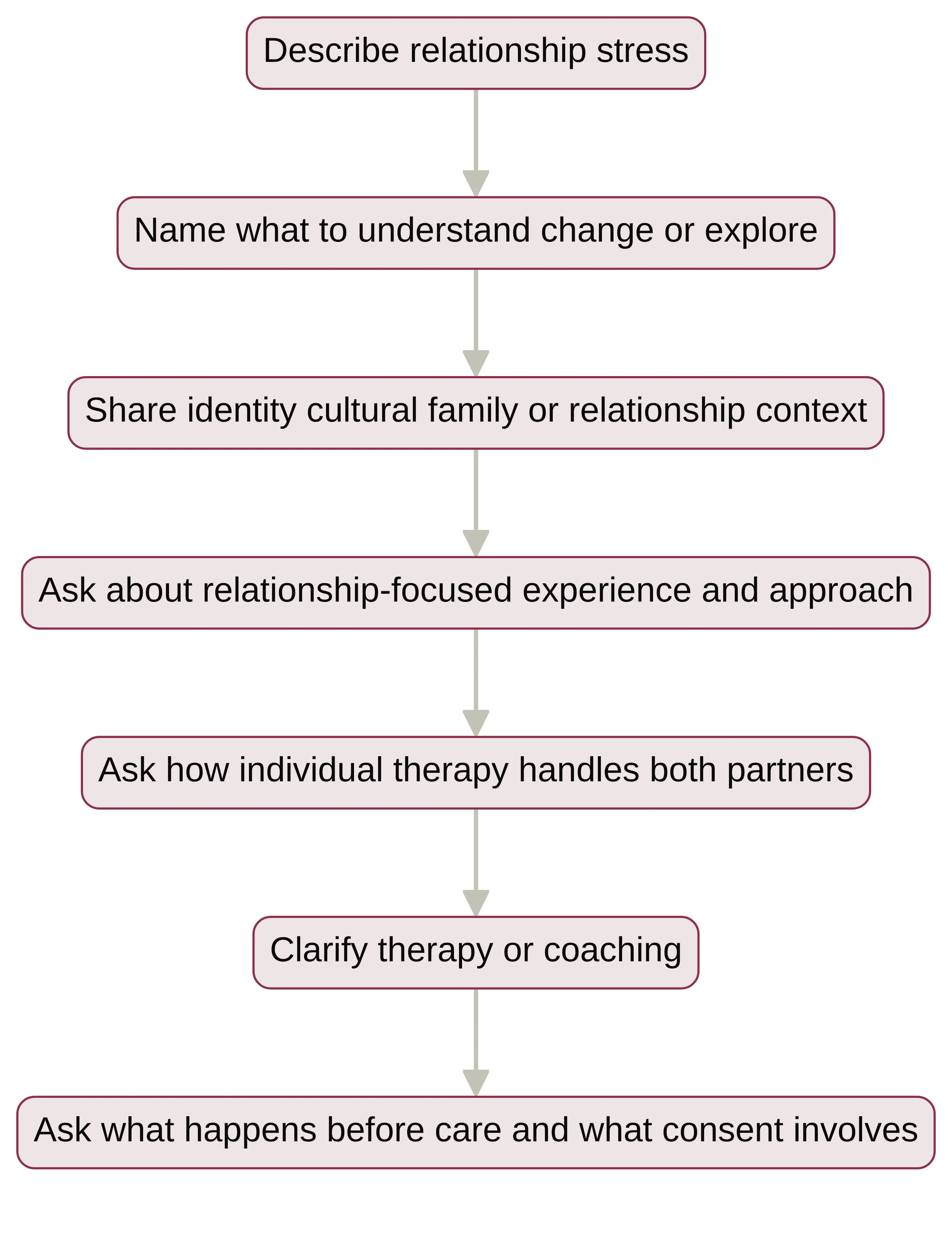
A simple conversation plan is:
- Describe the relationship stress in one or two sentences.
- Name what you want to understand, change, or explore.
- Share any identity, cultural, family, or relationship context that should shape the conversation.
- Ask about the therapist’s relationship-focused experience and approach.
- Ask how individual therapy would handle a concern that involves both partners.
- Clarify whether therapy or coaching matches the kind of support you described.
- Ask what happens before care begins and what consent involves.
A New York-focused selection guide recommends considering licensure, specialization, experience, therapeutic approach, and cultural responsiveness. Those criteria can structure your questions without turning the conversation into an interview you have to perform perfectly. You are looking for enough clarity to decide whether to continue.
You can also ask about practical fit, including the available location or format, before sharing more personal detail. If you are seeking support in New York or asking about an online option, say that plainly. Keep your first message focused on the care you are considering rather than trying to explain every relationship event.
RelationshipHQ’s stated process has three steps: learning about you, choosing a care experience, and giving consent to get started. That gives you a clear sequence for your own questions. First describe what brings you in; then ask what kind of care matches it; then decide whether you consent to begin.
RelationshipHQ’s process is designed around learning about you, choosing a care experience, and giving consent to get started. Bring your relationship concern, your questions about affirming care, and the format you are seeking so you can make an informed choice about the next step.
How RelationshipHQ describes individual therapy
RelationshipHQ describes individual therapy as a place to explore the significance of past experiences and how those experiences influence present thinking, relationships, and overall well-being. Our individual therapy addresses relationships, anxiety, intimacy, identity-related stress, work stress, low self-esteem, family-of-origin issues, and experiences involving racism, homophobia, or transphobia.
Our individual therapist specializes in couples, LGBTQ+, nonmonogamy, relational dynamics, and Gottman Therapy. Those details may matter if you want relationship support that recognizes identity and relationship structure as part of the context.
It gives you a way to bring your own concerns into therapy and explore how past experiences connect with the present. You can ask which parts of this offering match the issue you want to discuss and which questions should be answered before you begin.
If your concern includes anxiety, identity-related stress, intimacy, or experiences involving racism, homophobia, or transphobia, name that connection directly. If your concern is mainly a shared pattern between partners, ask how individual therapy would address the limits described in the previous section. Clear scope helps you choose care that matches what you want examined.
RelationshipHQ offers therapy for individuals, partners, and families and coaching for individuals, partners, families, and organizations. If you are in New York or seeking an online support option, include your preferred format when you ask about individual therapy. We can then discuss the care experience you are considering without turning coaching, workshops, or relationship experiences into substitutes for the individual therapy question.
What happens when you contact RelationshipHQ?
The next step is to describe the relationship stress you want to explore and the kind of affirming support you are seeking. Include whether you are asking about individual therapy in New York or an online format, what pattern or concern brought you here, and any identity or relationship context that should be respected.
RelationshipHQ’s process starts by learning about you, then choosing a care experience, and then giving consent to get started. You can use that conversation to discuss fit, scope, approach, and the questions you need answered.
What should you ask before choosing an individual therapist for relationship problems?
What should I consider when choosing a therapist for relationship problems?
When selecting a therapist, consider their licensure, specialization in relationship issues, experience with similar concerns, therapeutic approach, and cultural responsiveness.
How can I identify if individual therapy is suitable for my relationship stress?
Individual therapy may be suitable if you want to explore your reactions, needs, and past experiences related to your relationships. It can help you understand patterns and clarify what you want to work on.
What distinguishes individual therapy from coaching?
Individual therapy is a clinical practice focused on emotional struggles and mental health challenges, while coaching aims to help individuals uncover their own insights and answers.
What qualities should an affirming therapist possess?
An affirming therapist should demonstrate cultural competence, understand diverse identities, and be able to create a safe space for clients to express their experiences without needing to defend their identity.
How can I contact RelationshipHQ for individual therapy?
To contact RelationshipHQ, describe the relationship stress you want to explore, mention whether you’re seeking therapy in New York or online, and include any relevant identity or relationship context.
What types of issues can individual therapy address?
Individual therapy can address a range of issues including relationship stress, anxiety, identity-related concerns, intimacy, and experiences involving racism, homophobia, or transphobia.
What steps should I take before my first therapy session?
Before your first session, prepare by identifying the relationship stress you want to discuss, any patterns you’ve noticed, and the context that matters to you. This will help guide your conversation with the therapist.