
Could relationship coaching fit what you need?
Relationship coaching may fit you if you want practical support with dating, commitment decisions, breakups, or clearer relationships without making therapy the focus. Coaching usually centers on present concerns, actionable goals, and practical next steps, while therapy may focus more on healing, mental-health treatment, trauma, or psychological distress.
At RelationshipHQ, we offer coaching for individuals and partners. The choice depends less on the label and more on the kind of help you want right now. If you want space to clarify what you need, understand your patterns, practice communication, or decide what to do next, coaching may give you a useful structure for that work.
If your main need involves assessment or treatment for mental-health concerns, therapy may be the more fitting service. Couples therapy and relationship coaching are different services, so consider whether you want practical relationship guidance or a wider focus on emotional healing and psychological concerns.
A simple starting question is: “What do I want help doing?” If the answer involves making a decision, changing a conversation, understanding your relationship needs, or moving through a transition, continue with the questions below. If your answer points toward healing trauma, managing psychological distress, or seeking mental-health treatment, keep the therapy distinction in view.
What relationship coaching is
Relationship coaching is practical guidance for understanding your relationships and choosing your next steps. It can support communication, conflict resolution, deeper connection, and relationship skills for individuals and couples.
Coaching generally starts with what is happening now and what you want to change, understand, or decide. You might bring a repeated argument, uncertainty about commitment, difficulty dating, or questions about how to communicate a need. The work then turns a broad concern into a clearer goal and possible actions. That does not mean every concern has a quick answer. It means you have a defined place to examine the question and decide what deserves your attention first.
Coaching often includes several kinds of practical support:
- Naming the relationship question underneath a stressful moment.
- Separating your own needs, values, and limits from pressure or assumptions.
- Setting an actionable goal for a conversation or decision.
- Practicing a different way to express what you feel or need.
- Reviewing what happened and choosing a next step.
Our coaching helps individuals, partners, families, and organizations uncover their own voices, insights, and answers. For you, that can mean the coach is not handing you a universal script for your relationship. Instead, coaching can help you hear your own position more clearly and work from it.
Coaching is not a promise that another person will change, that a relationship will continue, or that a breakup will feel easy. It is a structured form of support for reflection, communication, and decisions. You remain the person who chooses what to say, what to ask for, and what action fits your situation.
You also do not need to arrive with a perfectly formed goal. “I keep avoiding a conversation,” “I am unsure whether to commit,” or “I want to understand what I need from dating” can be enough to begin describing the issue. A useful goal can take shape as you explain what is happening and what you want to understand.
What concerns can coaching support?
Relationship coaching can support questions about dating, commitment, breakups, self-discovery, and clearer relationships when you want practical guidance rather than a mental-health treatment focus. The right starting point is the concern you want to understand or act on, not a requirement to arrive with a polished goal.
You might use coaching to work through questions such as:
- Dating: How do you want to date, what are you looking for, and which boundaries or values matter to you?
- Commitment decisions: What does commitment mean to you, and what information do you need before making a choice?
- Breakups: How do you want to communicate a decision, create limits, or make sense of what comes next?
- Self-discovery: What are you learning about your needs, patterns, hopes, or fears in relationships?
- Clearer relationships: How can you say what you mean, listen to another person, or address a recurring conflict?
These topics can overlap. A dating question may become a values question. A commitment decision may involve a difficult conversation. A breakup may bring both grief and practical decisions about contact, boundaries, or shared responsibilities. Coaching can give you a place to separate those threads so you can decide which one to address first.
Our coaching service is available for individuals and partners. You can bring an individual question even when it involves a relationship, or you can attend with a partner when both of you want to work on communication or a shared decision. Our coaching also helps people uncover their own voices, insights, and answers, so your work can begin with your perspective rather than with a fixed relationship script.
A coaching conversation may be a useful fit when you can name a present concern and want help turning it into practical reflection or action. If the concern is mainly about mental-health treatment, psychological distress, or healing from trauma, use the therapy comparison in the next sections to think about a different kind of support.
You can make the concern more specific by finishing one of these sentences:
- “I want to decide whether…”
- “I need to have a conversation about…”
- “I keep noticing that I…”
- “I want to understand what I need from…”
- “I am preparing for a breakup and need help with…”
The sentence does not have to predict the outcome. It only needs to identify the part of your relationship life you want to examine.
How coaching differs from therapy
Relationship coaching and therapy can both involve honest conversation, reflection, and support, but they usually organize that work around different aims. Coaching generally emphasizes present concerns, goals, accountability, and practical next steps. Therapy may focus more on healing, mental-health treatment, trauma, psychological distress, and how the past affects the present.
| Question | Relationship coaching | Therapy |
|---|---|---|
| What is the main focus? | Present relationship concerns, goals, communication, and practical next steps. | Healing, mental-health treatment, emotional concerns, trauma, or psychological distress. |
| What might you work toward? | Clarifying a decision, setting an actionable goal, or practicing a communication strategy. | Understanding and treating psychological concerns or working through emotional pain. |
| What time frame receives more attention? | Coaching tends to focus more on the present and future. | Therapy may spend more time exploring the past and its effect on the present. |
| What is the professional boundary? | Coaching is distinguished from diagnosis and mental-health treatment. | Therapists can diagnose and treat mental-health conditions. |
The table describes general differences, not a rule that every session will feel the same. A coaching conversation can include emotions. Therapy can include practical goals. The question is which service is designed around the kind of support you are seeking.
The distinction also matters because psychotherapy is described as considering psychological issues more widely and deeply than health coaching, with psychotherapists trained to assess and diagnose multiple conditions. Relationship coaching should not be selected as a way to avoid care that addresses mental-health concerns. Choose it when your need is practical relationship guidance and your intended work fits that scope.
At RelationshipHQ, we offer coaching for individuals and partners, and we describe therapy as a path for emotional healing of past hurts or trauma. Those are different routes for different needs. You can use the difference to describe what you want help with before you decide which conversation to begin.
A practical way to compare the two is to identify the verb in your request. “Decide,” “practice,” “clarify,” and “communicate” may point toward coaching when the concern stays within that scope. “Treat,” “heal,” “assess,” or “work through trauma” may point toward therapy. These words are not a diagnosis. They are a way to name the kind of help you are seeking.
When therapy may be the better fit
Therapy may be the better fit when mental-health challenges are affecting your relationship or when you want support for healing, psychological distress, trauma, or mental-health treatment. A comparison of couples therapy and relationship coaching distinguishes couples therapy for situations involving mental-health challenges that affect the relationship from coaching for relationship support without a medical diagnosis or therapy.
You may want to consider therapy when your central question sounds like one of these:
- How can I address distress that is affecting my daily life or relationship?
- How can I work through past hurts or trauma?
- Do I need assessment or treatment for a mental-health condition?
- Are psychological concerns shaping the relationship in ways that require more than communication practice?
These questions do not mean you have to explain yourself perfectly before seeking help. They simply point toward a broader form of care than coaching is designed to provide.
We describe therapy as a path for emotional healing of past hurts or trauma. If that description matches what you want to address, therapy may be more aligned with your needs than a coaching plan focused on goals and practical next steps.
You can also have more than one relationship concern at the same time. You might want help with a conversation and also recognize a need for therapy. In that situation, do not force every concern into a coaching frame. Name the wider need and choose support that can address it.
Pay attention to the scope of the help you are asking for. If you want to understand a decision about commitment, prepare for a difficult conversation, or practice expressing a boundary, coaching may match that request. If the relationship concern is connected to psychological distress, trauma, or a need for assessment or treatment, therapy may be the more appropriate direction. Keep those questions separate instead of expecting one service to cover both.
What relationship coaching may involve
Relationship coaching may involve turning a relationship concern into a practical goal, exploring the interaction pattern around it, and choosing a next step you can consider or practice. Coaching sources describe goals, accountability, practical next steps, active listening, and role-playing as parts of this kind of work.
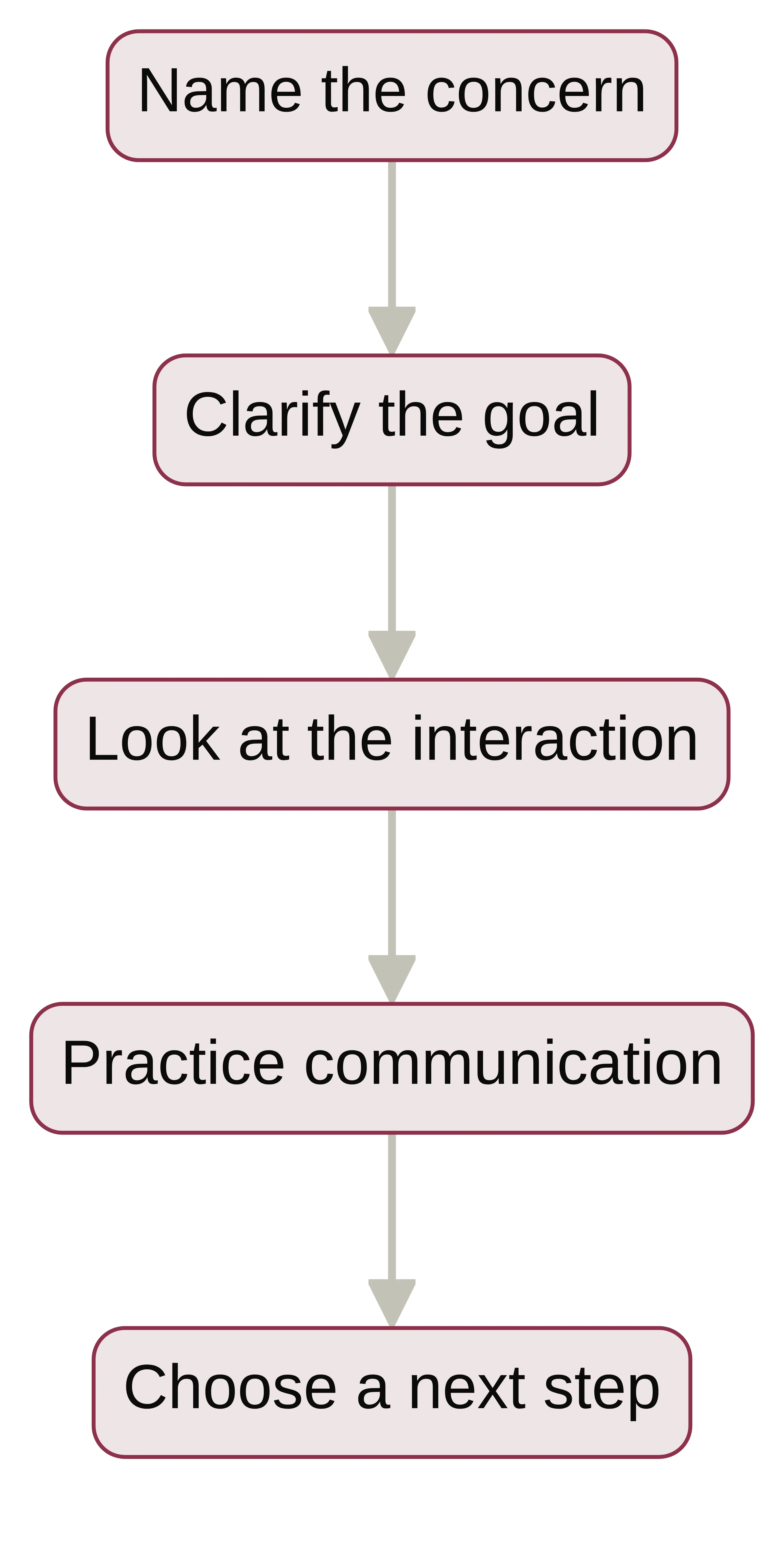
A coaching plan might move through steps like these:
- Name the concern. Describe what is happening now, such as uncertainty about commitment, a repeated argument, or difficulty expressing a need.
- Clarify the goal. Decide what you want to understand, communicate, practice, or choose. A goal can be modest and specific rather than a promise to fix the whole relationship.
- Look at the interaction. Consider what each person says, hears, assumes, or avoids. The purpose is to make the pattern easier to discuss, not to assign blame.
- Practice communication. Active listening can help you express feelings and needs, while role-playing can give you a way to practice a communication strategy before using it in a difficult conversation.
- Choose a next step. You might decide what to ask, what boundary to state, what conversation to have, or what information you still need.
The order can vary. A breakup question may need boundary planning before communication practice. A dating concern may begin with self-discovery rather than a conversation with another person. The useful part is the connection between the concern, the goal, and the action you are considering.
Some relationship-coaching practices also emphasize interpersonal intelligence and conflict-resolution skills, including through approaches such as the Gottman Method. You do not need to arrive knowing a named method. You need a concern you are willing to examine and enough openness to consider a different way of approaching it.
Our coaching helps people uncover their own voices, insights, and answers. That makes your perspective part of the work. A coach may offer questions, structure, or practice, but you still decide what your values and boundaries require.
Before you contact us, you can prepare a short working note:
- The situation you want to discuss.
- The decision, conversation, or pattern that feels most pressing.
- The kind of support you want, such as reflection, communication practice, or help organizing your next step.
- Whether you want to explore the issue alone or with a partner.
This note is for your own clarity. It does not need to be polished, and it does not commit you to a particular outcome.
Why an affirming setting can matter
An affirming relationship-coaching setting gives you room to talk about connection, vulnerability, identity, and conflict without treating who you are as a problem to explain or defend. That matters when your relationship questions are shaped by experiences of gender, sexuality, race, culture, family expectations, or belonging.
We offer an identity-affirming approach for Black, Brown, Indigenous, Queer, and TGNC people. We also prioritize the needs of people of color and the LGBTQ community. These are business commitments about the setting we aim to provide; they do not tell you what your relationship should look like or what decision you should make.
An affirming conversation can make space for details that a generic relationship script may leave out. You might want to discuss how a partner understands your identity, how family or community expectations affect commitment, how race or culture shapes conflict, or how to set boundaries around disclosure. You should be able to name those realities plainly while still focusing on the question you brought.
Affirming does not mean automatic agreement with every choice or a promise that a conversation will feel easy. It means the work can respect your identity and context while helping you examine needs, values, communication, and decisions. You remain free to define the relationship you want and the support you need.
If an affirming setting is part of your decision, include that in your own fit criteria. Look for support where LGBTQ+ identities and the experiences of people of color can be discussed as part of your life, not treated as a detour from relationship work.
You can also name the context that matters to you before the work begins. That might include your pronouns, the language you use for your relationship, cultural or family expectations, or the ways race, gender, sexuality, or disability affect your experience. You do not have to reduce those details to a side issue. They can shape the relationship question itself.
Who RelationshipHQ coaching is for
RelationshipHQ coaching is for individuals and partners who want practical guidance for dating, commitment decisions, breakups, self-discovery, or clearer relationships. We offer coaching for individuals, partners, families, and organizations, and this guide focuses on the individual and partner support most relevant to relationship questions.
You may be a reasonable fit for this kind of coaching if:
- You can name a present relationship concern, even if the answer is not clear.
- You want help with goals, communication, reflection, or practical next steps.
- You are willing to consider your own needs, values, and choices.
- You want an affirming setting that respects LGBTQ+ identities and the experiences of people of color.
- You are looking for relationship support rather than diagnosis or mental-health treatment.
You do not need to know exactly what to ask before you begin. A question such as “Should I stay?” may become several smaller questions about commitment, trust, values, communication, or timing. A question about dating may become a conversation about boundaries and what you want from a relationship. Coaching can help organize those questions so you can decide what deserves attention first.
Consider therapy instead when mental-health challenges are affecting the relationship, or when your main need is healing, treatment, assessment, trauma support, or help with psychological distress. The distinction is about the kind of support you need, not about whether your relationship concern is serious enough to discuss.
If that approach matches what you are seeking, prepare to explain the question you want to explore and the kind of practical support that would make the conversation useful.
Use this short fit check before taking the next step:
- Concern: Can you describe the relationship issue you want to examine?
- Purpose: Are you seeking reflection, communication practice, a decision process, or another practical next step?
- Scope: Does your request stay within relationship guidance rather than mental-health treatment or assessment?
- Setting: Would an affirming approach for LGBTQ+ and BIPOC people help you speak openly about your situation?
- Format: Do you want to begin with individual support or explore the concern with a partner?
If most of your answers point toward practical relationship guidance, coaching may be worth exploring. If the main need falls outside that scope, use the therapy distinction rather than trying to make coaching carry it.
How to take the next step toward coaching
The next step is to decide whether your main need is practical relationship guidance or therapy focused on healing, treatment, or psychological concerns. If coaching fits, write down the concern you want to bring, the decision or conversation you are facing, and what you hope to understand or practice.
You can also note whether you want individual or partner support, how an affirming setting should account for your identity and context, and what kind of conversation would feel useful. Those details can help you communicate your needs clearly without needing a complete plan in advance. We offer coaching for individuals and partners, and our coaching helps people uncover their own voices, insights, and answers.
A qualified professional decides whether a particular service is suitable for your individual needs. Use the distinction in this guide as a starting point: choose coaching for practical relationship questions within its scope, and seek therapy when your needs involve mental-health treatment, assessment, trauma, or psychological distress.
When you are ready to ask about starting coaching, include the concern you want to discuss, whether you are seeking individual or partner support, and any context that would help us understand what you need.
What should I consider before choosing coaching or therapy?
What is relationship coaching?
Relationship coaching provides practical guidance for individuals and couples to improve communication, resolve conflicts, and enhance relationship skills. It focuses on present concerns and actionable goals.
What types of relationship concerns can coaching help with?
Coaching can support issues related to dating, commitment decisions, breakups, self-discovery, and clearer relationships, focusing on practical guidance rather than mental health treatment.
Who is relationship coaching suitable for?
Coaching is for individuals and partners seeking practical support for relationship issues without needing mental health treatment. It is particularly affirming for LGBTQ+ and BIPOC individuals.
How can I contact RelationshipHQ for coaching?
You can reach out to RelationshipHQ by completing the Coaching Registration form, where you can describe your concerns and specify whether you want individual or partner support.